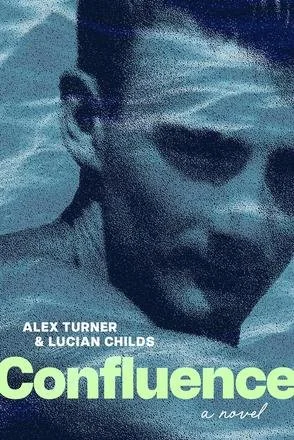
I met Alex Turner and Lucian Childs some years ago in Toronto. Alex was an amazing artist and kind and human being. I’ve worked with Lucian on a few projects over the years and was thrilled by the attention and excitement around his award-winning debut, Dreaming Home.
Alex died in 2019. When Lucian approached me about reading and commenting on an early draft of Alex’ unpublished stories, I did so gratefully. Inside this manuscript was an incredibly story of a young gay man finding love and community in British Columbia, decades before gay rights were commonplace. Lucian has worked diligently on the manuscript since then, filling in some of the missing pieces while staying true to the vision and voice of Alex.
This fall, the result of that labour of love, a co-mingling of minds and creativity, appears in Canadian bookstores. Confluence is great storytelling, a fresh and vital novel. Pick it up at your local bookstores! Lucian was kind enough to answer a few questions about the book.
_____
Confluence is truly a labour of love, co-written between you and your late husband Alex Turner. Alex had amassed a number of linked stories before he died. When and why did you decide you wanted to finish the project?
Alex had been encouraged as a young man to write short fiction by his favourite aunt, Marjorie Gow. So in 1992, when he retired from teaching art at Central Technical School in Toronto, he started heeding her advice. For the next twenty years, he worked on and off on the stories. It was touching to see this devotion, which persisted until we had to move into the Palliative Care Unit at Hennick Bridgepoint Hospital. Since it was clear he’d never be able to finish the project, one day at the PCU he passed the baton to me.
In 2022, before traveling to his hometown of Harrison Hot Springs for a retrospective exhibit of his artwork, I started looking at his stories, thinking I’d quickly cobble them together for his friends. I was surprised to find that the stories, though rough, had impactful dramatic arcs that built to a satisfying whole. And he wrote beautifully, especially about his beloved British Columbia: the nature around his hometown, but also about queer and bohemian life in early ’60s Vancouver. Seeing the quality and scope of this story cycle, I decided completing his work deserved serious attention. Of course, that was, and is, all mixed up with my grieving for him and my desire to keep his memory alive in the world.
The novel has gone through several iterations. Can you speak briefly about the process of pulling it together? How challenging was it to make creative decisions as you revised and completed the work?
Since the stories are based on his early life, it required a deep dive into his personal history, which in those first few years after he died was difficult, but exactly where I wanted to be. A couple of the stories were in pretty good shape. Others had strong narratives that could be repurposed to match the novel’s developing storyline. Many required something akin to archaeology—sifting through the dead ends and copious material he’d generated over hundreds of drafts.
So, the challenge was to find the text and incident that fit the novel he had begun to spin. And to flesh out important moments he’d underwritten, as well as the many narrative gaps. My working principle: new material had to come either from one of his stories or from the editorial notes he’d left me, from his personal journals, recollections he’d shared, or photos and letters from the day.
Several entries in his personal journal described the apartment house in Vancouver he shared with a crazy collection of kids. Their parties were real blowouts and one Halloween everyone came as their favourite disease! How delicious! Since he said no more about it, I wrote the scene in his voice—one so similar to mine it spared me the drudgery of sustained literary ventriloquism.
The novel follows a young gay man from small-town British Columbia as he moves to the big city, explores desire, falls in love and builds a life. It’s such a powerful and granular look at gay life in Canada at a time long before Stonewall and Pride. What was Alex’s vision for Teddy (later Ted) and how did stories from his own life shape the direction of the book?
As with most writers, Alex’s fiction was a vantage point from which he surveyed his own life. Like Teddy/Ted, Alex was a BC boy from Harrison Hot Springs, who was at loose ends in Vancouver after high school, until he began studying art. And the characters and places in the novel all have real-world equivalents. Alex’s parents, Sam and Bess, are the models for Ted’s. And Alex’s early romances serve as the progenitors of Ted’s—the straight Vern became the novel’s unrequited love interest, and the very gay Doug served as the basis for the on-again off-again Marc. Alex’s beloved stomping grounds around Lake Harrison and Vancouver are not so much locations, as they are markers of these relationships.
Even so, I don’t think the work approaches metafiction or memoir. These details from Alex’s life are in service of a story that is similar, but not identical to his own. This alchemical quality is one of the aspects of fiction writing I love.
Did you and Alex share your writing with one another? What was his own process, as a writer? And what were his goals and hopes for his work?
Alex was my main beta-reader, as we used to call them. He was very patient, going over draft after draft of my work. Though he must have gotten sick of those (probably terrible) early stories of mine, he never complained about it. He was somewhat sparing in asking me to look at his work, since I always handed back his print-outs dripping in red! (My edits to my own stories were even worse!)
We never really talked about process, but you can see from the stories he was, as I am, attracted to tight dramatic arcs. Each of the tales that comprise the novel manages a crisis. I hesitate to say “resolve,” since I don’t think either of us considered that to be the role of fiction.
As to goals, the stories for him seemed a pure play. He shared some with friends but never submitted any of them. And though he was a successful educator, who had a profound influence on many students, he was pretty down on himself for not having been a more successful artist. I suppose my finishing and amplifying his stories is my way of trying to fix that.
Finally, now that the novel is about to launch itself out into the world, how are you feeling, Lucian? And how do you think Alex would feel, knowing that his stories will now reach a much wider audience?
The novel is starting to get some attention, though, as with any book it’s all a bit hit and miss. So, I struggle to keep both hope and disappointment in check. I’m excited about the work artistically but am equally glad the story of Alex’s early life will remain alive in the world. Most of all, I’m looking forward to the launch events with friends in Toronto and in Anchorage, where I used to live. And especially to the event in Agassiz—a twin city to Harrison—that will be held on September 17: his birthday.
Alex would be gobsmacked by what his stories have become, but also, perhaps, unsurprised, knowing that before he died we’d entered into a kind of unspoken compact about his work. If he’s somewhere out there still, I’m sure he’s very pleased.
_____
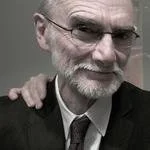
Alex Turner (1940–2019) graduated from the Vancouver School of Art and the University of British Columbia and subsequently taught in Toronto at the Art Centre of the Central Technical School. After retirement, Alex turned to fiction, and his short fiction appears in the literary magazine Prairie Fire. Confluence is his debut novel.
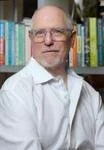
Lucian Childs is a fiction writer whose debut, the novel-in-stories Dreaming Home (Biblioasis, 2023), won the Fred Kerner Book Award and was shortlisted for the Rakuten Kobo Emerging Writer Prize in literary fiction. With his late husband, Alex Turner, he authored the novel-in-stories Confluence (Arsenal Pulp Press, 2026). He is a contributing editor of Building Fires in the Snow: a collection of Alaska LGBTQ short fiction and poetry (University of Alaska Press, 2016), a Lambda Literary Award finalist. His stories, essays, and reviews have appeared on WritersDigest.com and in the literary journals Grain, The Ex-Puritan, Plenitude, and Prairie Fire, among others. Originally from Dallas, Texas, he now lives in Toronto. For more about his work, please visit www.lucianchilds.com.